Activity comparison
Puzzle and logic construction games: choose the constraint you want to solve
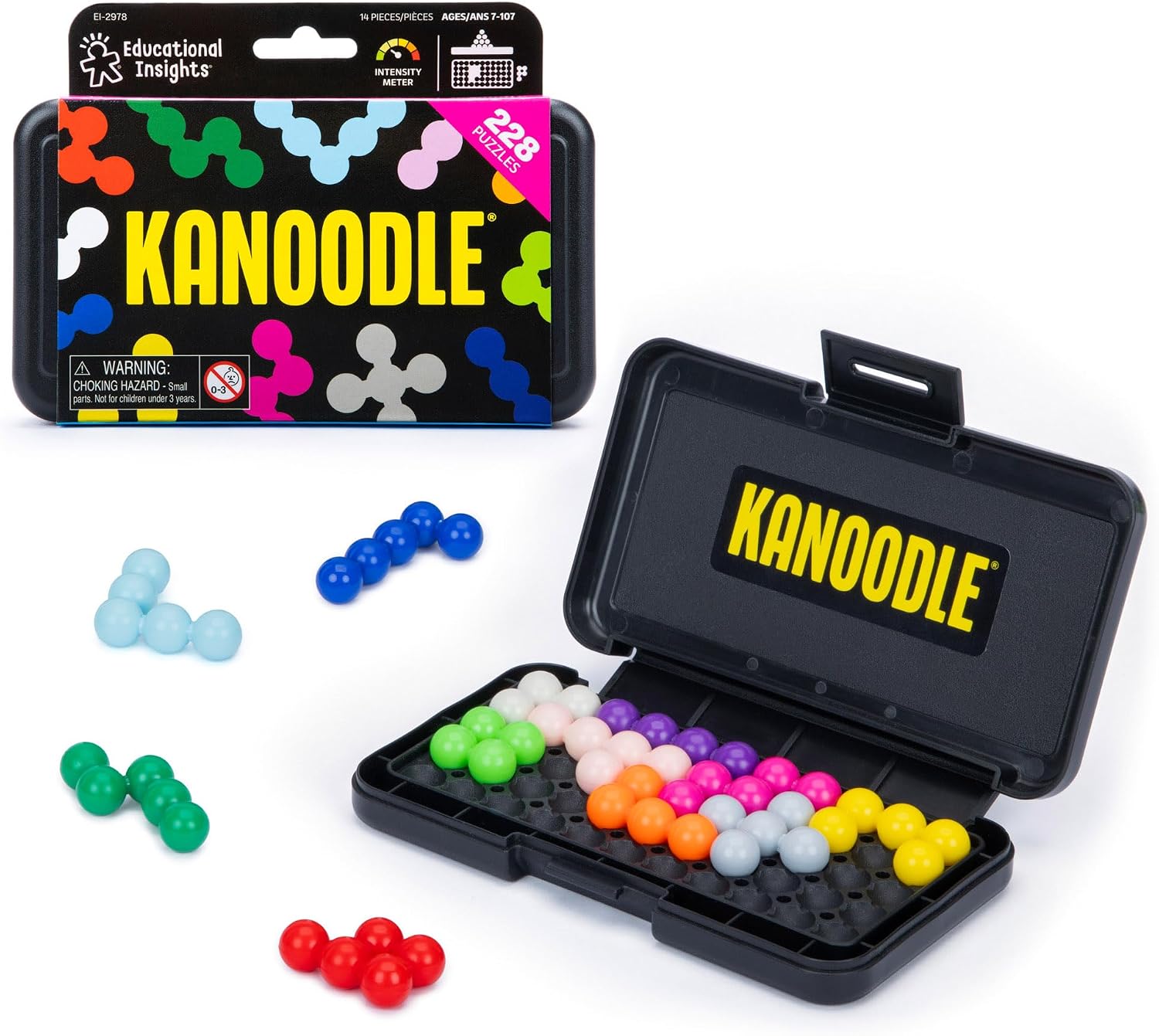
Our Pick: Kanoodle for compact physical packing puzzles
Our pick is Educational Insights Kanoodle for a player who wants to arrange physical pieces in a compact case rather than build a marble route or race across a larger grid. The captured package identifies EI-2978, an advertised age range beginning at 7, and a small-parts choking warning excluding children under three. That label is not a guarantee that every seven-year-old can solve the challenges independently. Follow the actual package and instructions, particularly where younger children share the space.
The choice is about the documented activity format. The captured listing describes twelve puzzle pieces, a case that doubles as the board and a guide with 228 two-dimensional and three-dimensional puzzle challenges. The original package also says 228 puzzles. This gives the purchaser a concrete format to compare without relying on promises about intelligence, school performance or improved reasoning.
We have not personally tested the puzzles, timed solutions or measured learning outcomes. Beginner-to-expert labels describe the product’s challenge collection, not an assessment of a particular player. A compact case is useful for storing a puzzle set, but it does not make loose pieces childproof or establish that every component will stay contained during travel.
Kanoodle: distinguish puzzle pieces from the package total
The photographed package says fourteen pieces in total, while the captured listing describes twelve puzzle pieces plus a case and guide. We are not promising how the manufacturer accounts for every item in that total. The important supported detail is the listing’s twelve physical puzzle pieces and the original EI-2978 identity, not an inventory borrowed from a different Kanoodle edition.
Do not substitute Kanoodle Genius, a larger variation or another challenge-count edition when checking the box. Similar names do not establish identical pieces, starting arrangements or directions. The exact maker’s guide page was unavailable in the source checked, so detailed rule exceptions and the complete printed instructions remain unverified here. Use the matching supplied guide before relying on a particular puzzle mode.
This is our source-based preference for physical packing in a portable board-and-case format. It is not a claim that the activity is universally easy, that a child needs no reading help or that completing a challenge produces a particular cognitive result. An adult may need to help interpret the starting layout and identify which pieces remain to be placed.
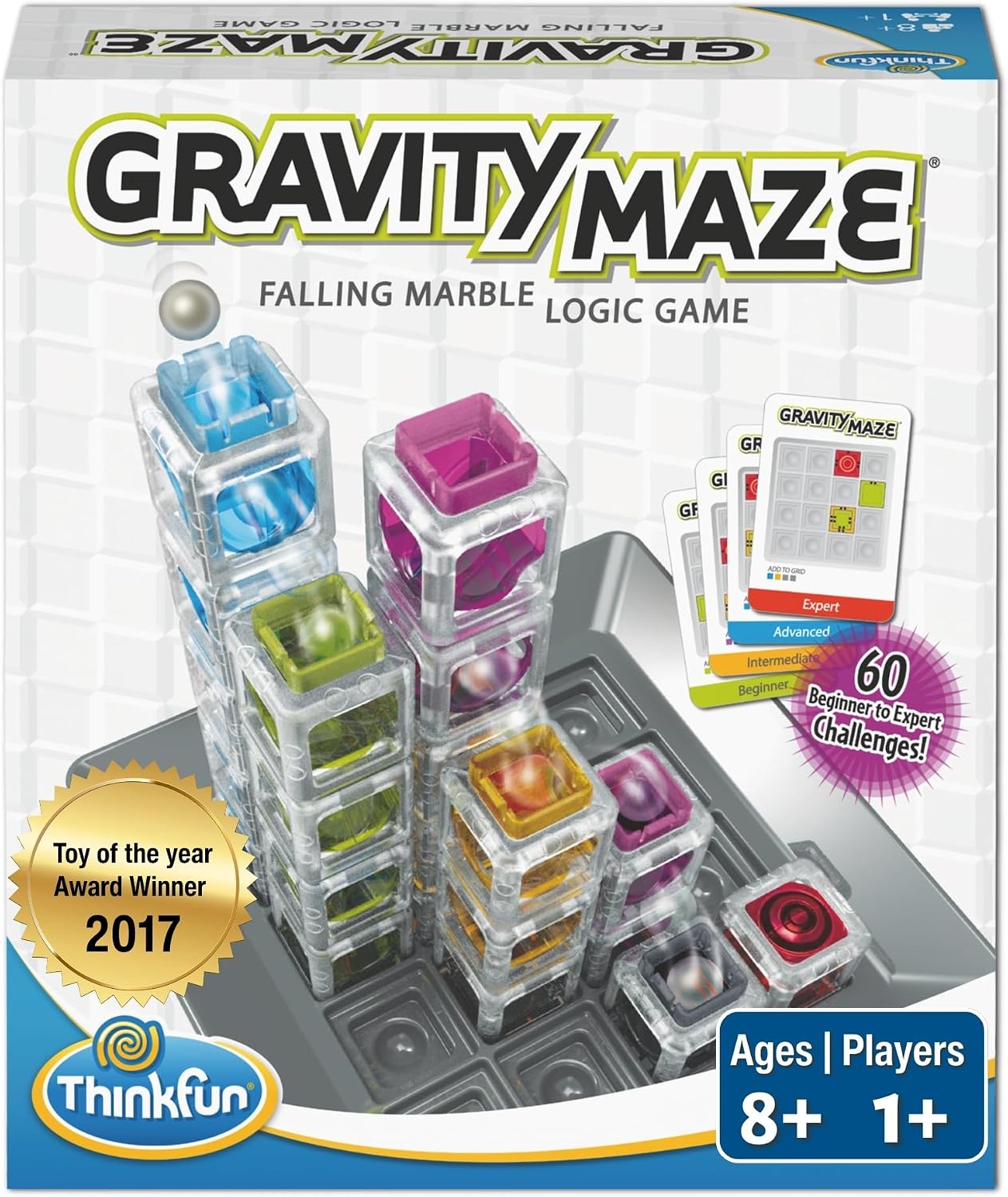
Gravity Maze: the tower-and-marble alternative
ThinkFun Gravity Maze is the alternative for a player who wants a visible route through three-dimensional towers rather than filling a flat arrangement. The exact captured title targets ages 8–12, and the original package is marked 8+. It also identifies a falling-marble logic game with sixty challenges. Check the actual complete warning panel and handling instructions before use; the captured front does not establish every warning for the small marbles and other components.
The exact listing identifies one game grid, ten Gravity Maze towers, three marbles, sixty challenges and instructions. We are not substituting a differently described inventory from an older manual or another version. In particular, a separate source’s nine-towers-plus-target wording should not be treated as an explained count equivalence without a model-matched inventory.
The original image shows challenge cards, the grid and colored towers, supporting the physical construction format. It does not prove that every pictured route is a solution to every challenge or that a particular player can complete the sequence without help. Follow the actual challenge setup and rules in the supplied instructions.
Its rule page was unavailable in the source checked. Detailed placement rules, exceptions, difficulty progression and the full warning inventory therefore remain checks for the exact box. The appeal is the documented tower-and-marble constraint format, not a promise of improved spatial ability or a measured educational benefit.
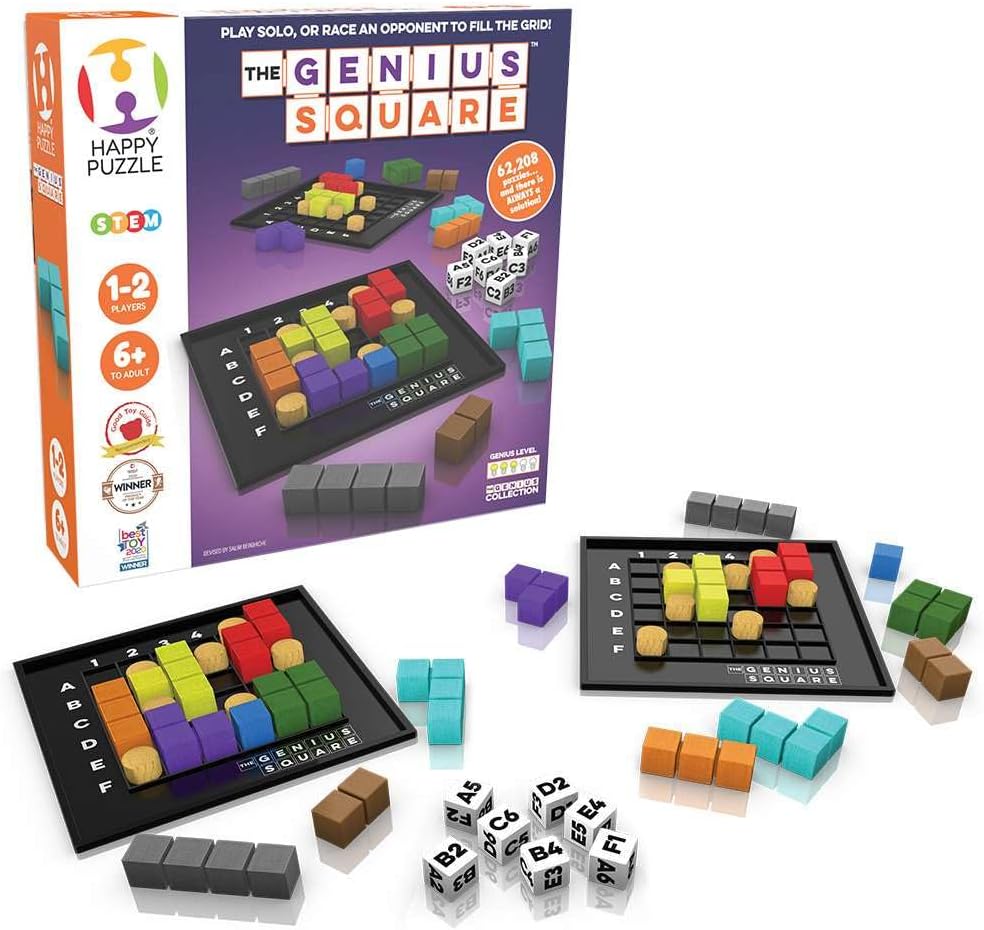
The Genius Square: dice, blockers and grid filling
The Genius Square is the alternative for a player who wants to fill a grid under a changing set of blocked positions, either alone or with another player. The original package identifies ages 6 to adult and one or two players. A complete warning panel was not captured, so do not infer that warnings are absent or that the lower advertised age proves a safer activity than the other games.
The captured listing describes two grids, seven dice, two sets of seven blockers and two sets of nine colored shapes. The maker explains the core activity: use the dice coordinates to position the blockers, then arrange the shapes in the remaining spaces. The original image matches that physical grid-and-piece format.
There is an important counting distinction. The maker describes 62,208 possible puzzle configurations, while the captured listing uses solution language. A number of starting configurations is not automatically the total number of solutions. We have not independently checked the combinatorial claim or verified every arrangement, and we are not promising that every player will find a solution quickly.
The maker says each permitted configuration has at least one solution. Treat that as a maker’s description of the game, not a hands-on verification by us. Follow the actual rules for legal dice positions, piece placement and solo or paired play. We do not promise that racing improves ability, that every challenge has the same difficulty or that speed is the right goal for every player.
Pick the kind of constraint, not the biggest claim
Choose Kanoodle for the compact physical packing format within its advertised 7+ starting range and warnings. Consider Gravity Maze for an 8+ tower-and-marble route activity, or The Genius Square for a 6+ grid-filling format with solo or paired play. Those are different documented activities, not equivalent measures of intelligence or fixed steps in a learning progression.
Before choosing, look at a model-matched starting example and the adult help available. A player may enjoy one kind of constraint more than another without that preference saying anything about aptitude. Check the actual box’s age, warnings, inventory and instructions rather than using an award badge or a large puzzle number as the deciding evidence.
Evidence and buying limits
These are source-based editorial choices, not hands-on tests or verified live offers. Prices, grades and purchase links remain unpublished. Customer-answer material does not resolve rules, safe ages, exact inventory or learning outcomes. Unsupported manual details and configuration-count interpretations stay qualified rather than being filled in from another edition.